
Here’s what most developers get wrong.
They build todo apps. Weather apps. Another Netflix clone.
Then they wonder why nobody responds.
Hiring managers in 2026 are drowning in applications. Your portfolio has maybe three minutes to prove you’re different.
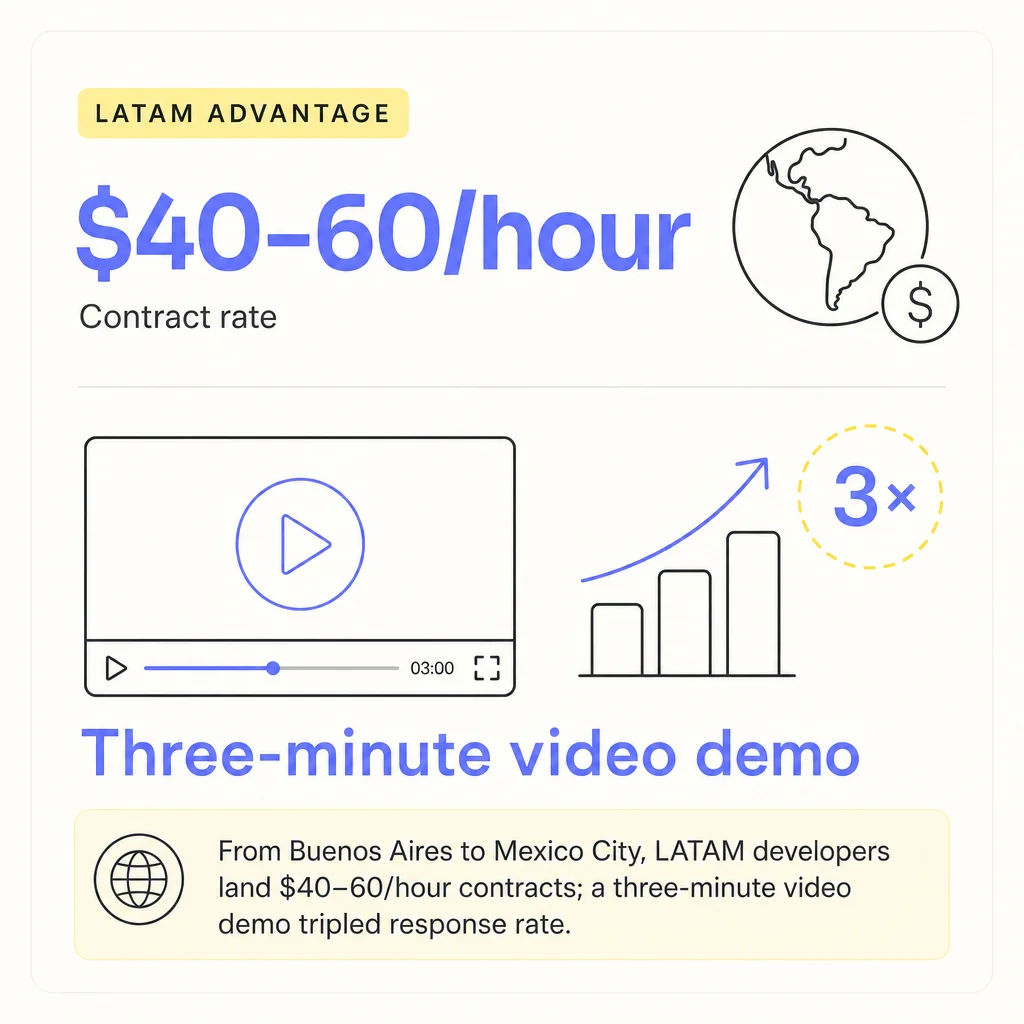
From Buenos Aires to Bogotá, from São Paulo to Mexico City—the developers landing $40–60/hour contracts aren’t showing off textbook projects.
They’re showing battle scars.
A Django API that handles real traffic. A FastAPI backend deployed on AWS with uptime metrics. A data pipeline that actually processes something meaningful.
One developer from Medellín told me he got hired within a week of adding one thing to his portfolio: a live FastAPI e-commerce backend with a Postman collection anyone could test.
The hiring manager sent an offer two days later.
Ready to Get Hired By Employers Actively Hiring Latin American Remote Workers?
Sign up for an account for Free and earn ins US Dollars today!
What “Real” Actually Means
Real doesn’t mean you worked for Google.
It means you solved a problem that matters.
Pick projects that mirror what companies actually need. Not what tutorials tell you to build.
A logistics API using FastAPI, Docker, and PostgreSQL shows you understand how products scale.
A real-time chat app with Django Channels and WebSockets proves you can handle async complexity.
Data pipelines with Airflow and Pandas are gold for any company doing AI work in 2026.
The pattern here: choose projects where you can show metrics.
“Reduced API response time by 40% using Redis caching” beats “built an API” every single time.
And here’s the LATAM advantage nobody talks about: you can deploy these on free tiers. Railway.app, Render.com, even AWS Lightsail has South American regions now.
No excuses about hosting costs.
Your GitHub Is Your Handshake
Let me be blunt about GitHub.
If your contribution graph looks like a ghost town, hiring managers assume you’re not serious.
They’re not wrong to think that way.
Remote work means they can’t tap you on the shoulder. They need proof you ship code consistently. That you finish what you start. That you won’t vanish when things get hard.
Your GitHub should tell that story.
100+ commits in the last six months.
Pull requests that got merged.
Issues you actually resolved.
Not perfect code—nobody expects that. But clean, testable, production-ready code.
Type hints.
Pytest coverage above 80%.
A Dockerfile that actually works.
Environment variables properly hidden.
One recruiter told me she automatically rejects portfolios with untested code. “Remote means no pair programming safety net,” she said. “If they don’t test locally, they won’t test in production.”
The README That Sells
Your README isn’t documentation.
It’s a sales page.
Start with the problem. Then your solution. Then why you made specific tech decisions. Then metrics proving it worked.
End with “why this scales.”
Here’s a trick that works especially well for Latin American developers: write it in both English and Spanish. Shows you can communicate across cultures. Shows you’re thinking about diverse teams.
And contribute to open source. Even small contributions to established Python packages signal something important: you can work with other people’s code. You can follow standards. You can collaborate remotely.
That’s exactly what they’re hiring for.
The Trust Gap (And How Video Closes It)
Static portfolios are dead.
A link to your GitHub is fine. A deployed app is better. But you know what actually converts?
A two-minute Loom video walking through your code.
“Here’s how I debugged this performance bottleneck.”
“Watch me deploy this endpoint and load test it to 5,000 concurrent users.”
“This is how I structured the database to handle eventual consistency.”
The hiring manager hears your voice. Sees how you think. Watches you solve problems in real-time.
Suddenly you’re not just another application from South America. You’re a real person who clearly knows their stuff.
This is especially powerful for LATAM developers because it demolishes the “communication barrier” myth. Record in clear English. Show your screen. Explain your thinking.
One developer from Colombia told me he added a three-minute video demo to his portfolio and his response rate tripled.
Not 30%. Not 50%. Tripled.
The LATAM Advantage Nobody’s Packaging Right
You have something developers in San Francisco don’t have.
You’re in a timezone that overlaps 4–6 hours with US business hours. You cost a third of what local developers charge. And tech hubs like Bogotá, Buenos Aires, and São Paulo are producing world-class talent.
But most portfolios don’t leverage this.
Add a timezone overlap calculator. Literally link to WorldTimeBuddy showing “4 hours daily overlap with EST.”
Show you understand async communication. Include a screenshot of how you structure daily standups in Notion or Slack.
Mention you’re set up for USD payments through Wise or TransferWise.
These tiny details answer questions hiring managers don’t want to ask: “Will this be a logistical nightmare?”
Make it easy for them to say yes.
The Argentina/Brazil/Colombia/Mexico Playbook
Each country has specific advantages.
Argentina: If you’ve built anything with payment integrations, show it. Mercado Pago integrations win Brazilian and US fintech roles. Even a Stripe or PayPal clone demonstrates you understand money movement.
Colombia: Emphasize cloud experience. AWS and GCP have huge presences in Medellín and Bogotá. Use the free AWS credits from startup programs. Deploy everything there.
Brazil: Full-stack Python + React is your ticket. Australian agencies especially love this combination. Use Vercel for instant deploys that just work.
Mexico: Nearshore advantage with US clients. Highlight timezone overlap even more aggressively. Same business hours = massive selling point.
What Actually Gets You Past Screening
Here’s what hiring managers do after they like your portfolio.
They give you a real task.
Not FizzBuzz. A actual problem their team faces.
Your portfolio should prove you’ve already solved problems like theirs.
Include a “Backlog” section showing real fixes. “Fixed SQLAlchemy N+1 query problem—here’s the before and after.”
Add AI/ML projects if you have them. LangChain with FastAPI. Simple LLM agents. These are exploding in 2026 and most portfolios don’t show them.
Tell scalability stories. “Migrated monolith to Kubernetes—handled 50,000 concurrent users.”
Numbers. Metrics. Evidence.
What Kills Your Chances
Let’s talk about red flags.
Generic machine learning models everyone has.
No mobile-responsive frontend even for backend roles (they check).
Missing cost information—they want to know it runs on a $5/month VPS, not some enterprise setup.
Dead repositories.
Code without tests.
READMEs that just say “Python project.”
These scream “not serious.”
And here’s one nobody mentions: if your portfolio takes more than 10 seconds to load, you’ve already lost. Hosting in South America? Use CDNs. Optimize images. Make it fast.
Speed signals competence.
Your 48-Hour Action Plan
Stop reading and start building.
Take your best freelance project. Sanitize any sensitive data.
Deploy it to Railway with proper metrics tracking.
Record a two-minute video demo.
Update your GitHub README with specific LATAM strengths.
Post to r/forhire asking for portfolio reviews.
Use New Relic’s free tier for metrics. GitHub Pages plus Framer for a polished portfolio site. Railway.app has Latin American servers—use them.
The developers getting hired aren’t the ones with perfect portfolios.
They’re the ones with portfolios that answer the real question: “Can I trust this person to deliver remotely?”
Build yours to say yes.
Author

Ready to Find Your Next Great Hire?
Join our growing community of employers and start connecting with skilled candidates in Latin America.