
I remember the first time someone told me they were paying $125 an hour for an SEO specialist in San Francisco.
My jaw dropped.
Because I knew someone in Medellín doing the exact same work (maybe better) for $18 an hour. Same tools. Same results.
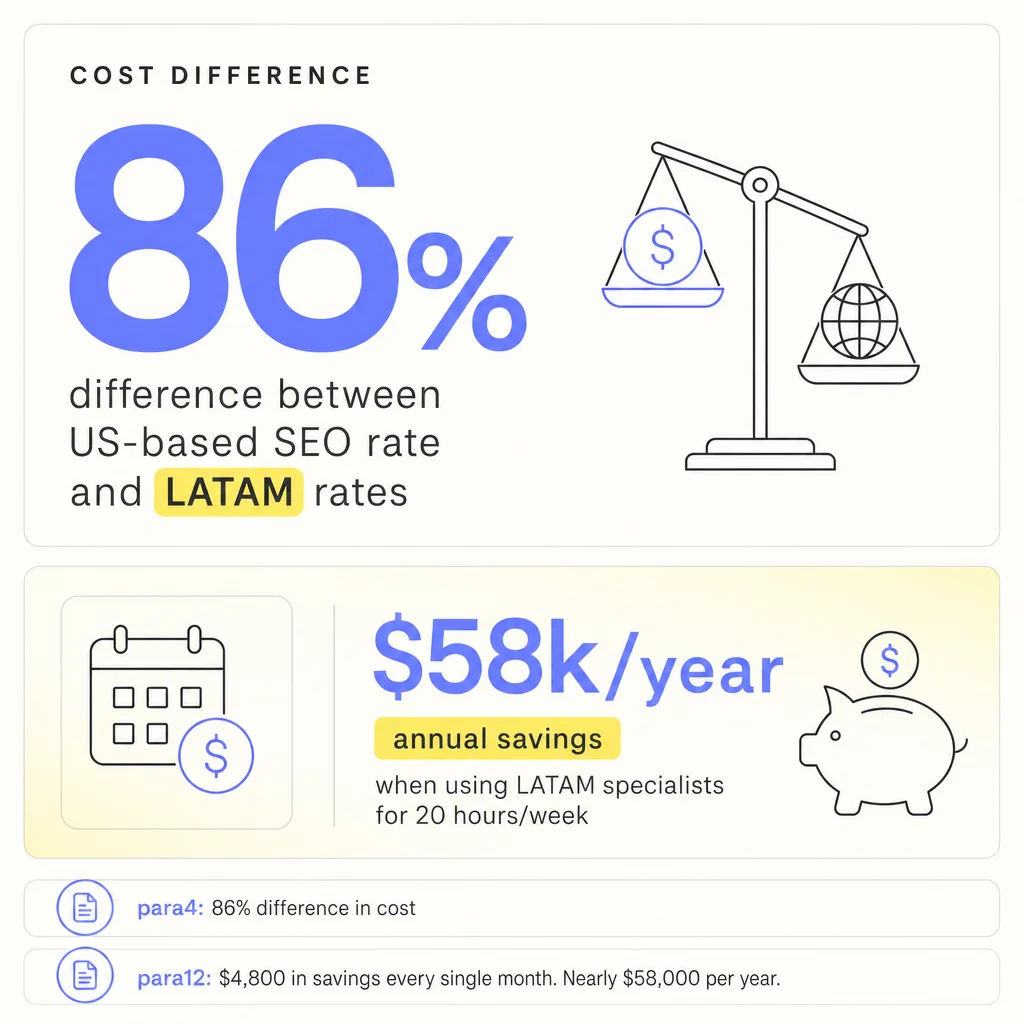
That’s an 86% difference in cost. Let me show you the real numbers.
Are You Looking to Hire in Latin America and Unsure Where to Start?
Sign up for an account and recruit your next employee within minutes!
The actual cost difference (and it’s bigger than you think)
Here’s what you’d pay for a mid-level SEO specialist with 3–5 years of experience:
United States: $50–100 per hour, or roughly $100,000–$200,000 annually for full-time.
United Kingdom: $40–80 per hour.
Australia: $45–90 per hour.
Latin America: $10–25 per hour, or $20,000–$50,000 annually.
That’s not a typo.
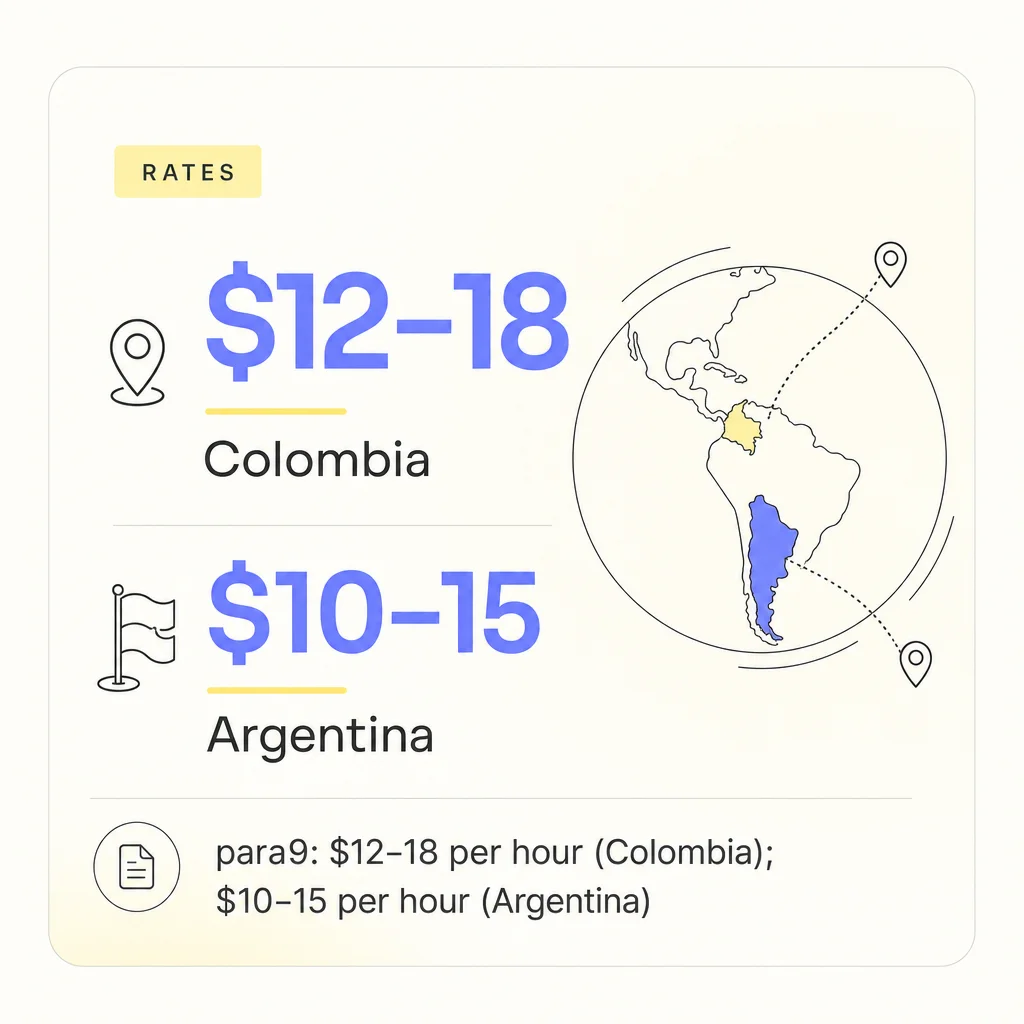
A Colombian SEO specialist who knows GA4, Semrush, technical audits, and can optimize for AI search will typically charge $12–18 per hour. An Argentinian with the same skills? Often $10–15.
Let’s do the math on a real scenario.
You need someone 20 hours per week. That’s pretty standard for ongoing SEO work — keyword research, content optimization, technical fixes, reporting.
US freelancer at $75/hour: $6,000 per month
Colombian specialist at $15/hour: $1,200 per month
That’s $4,800 in savings every single month. Nearly $58,000 per year.
And if you scale to a full team? The numbers get even more dramatic.
Why the gap exists (it’s not what you think)
Most people assume lower rates mean lower quality.
They’re wrong.
The cost difference has nothing to do with skill level. It’s pure economics.
Cost of living is wildly different. A great apartment in Bogotá runs $500–800 a month. That same apartment in Austin? $2,000–3,000. A talented SEO specialist in Colombia earning $3,000 per month lives comfortably. That same person in the US would be struggling at $36,000 annually.
Local salary benchmarks set the floor. In Colombia, a senior marketing role at a local company pays $40,000–$55,000 per year. In the US, it’s $120,000–$150,000. Remote workers price themselves competitively with their local market, not yours.
Currency exchange amplifies your buying power. When the Argentine peso weakens or the Colombian peso fluctuates, your US dollars stretch further. A $15/hour rate that feels low to you might be a premium rate locally.
There’s serious competition for remote work. Millions of talented professionals across Latin America want remote positions with US companies. This isn’t exploitation — it’s opportunity. These roles often pay 2–3x what local companies offer.
One more thing people miss: you’re not paying for US overhead.
No payroll taxes. No health insurance. No 401(k) matching. No office space.
When you hire a contractor from Latin America, you pay for the work. That’s it.
What you actually get for your money
Let me be clear about something: these aren’t junior-level people learning on your dime.
Here’s what a solid mid-level LATAM SEO specialist typically brings:
Technical skills: Google Analytics 4, Google Search Console, Semrush, Ahrefs, Screaming Frog. They can run technical audits, fix crawl errors, optimize site speed, and handle schema markup.
Content optimization: They understand search intent, keyword research, on-page SEO, and how to optimize for featured snippets and AI overviews.
English fluency: Near-native in most cases, especially in Colombia, Argentina, and Mexico. They’ve been consuming US content, working with US clients, and speaking English professionally for years.
Time zone overlap: This is huge. Someone in Bogotá is on the same schedule as the US East Coast. Mexico City is Central time. You can have real-time Slack conversations, join Zoom calls, and collaborate like they’re in the next state over.
Where to find these people (the platforms that actually work)
You can’t just post “hiring cheap SEO” and expect great results.
You need to know where serious Latin American professionals actually look for work.
HireTalent.LAT: Built specifically for hiring remote workers across Latin America. Candidates are pre-vetted for skills and work history, so you are not sorting through unqualified applications hoping to find someone worth interviewing. Rates typically run $10 to $20 per hour for experienced SEO specialists, and you hire directly without agency markups.
Upwork: Obvious but effective. Filter by location (Colombia, Mexico, Argentina), search for “SEO specialist,” and look for people with US client reviews. Expect rates between $10 to $25 per hour for quality candidates.
LinkedIn: Underrated. Search “SEO specialist Colombia remote” or “SEO Mexico City” and you will find thousands of profiles, many actively looking for US clients.
Specialized agencies: Agencies like Athyna or LatamADTalent handle the vetting for you. They charge a placement fee but guarantee English-fluent, experienced hires. Can be worth it if you’re hiring multiple people.
One thing I’ve learned: be specific about what you need.
Don’t post vague descriptions. List the actual tools (GA4, Semrush, Screaming Frog). Mention if you need local SEO experience or e-commerce SEO. Specify your time zone requirements.
The better your job post, the better your applicants.
How to vet them properly (don’t skip this part)
Here’s where people mess up.
They see the low rate, get excited, hire someone immediately, then wonder why it didn’t work out.
You still need to vet properly.
Start with a short English conversation. Five minutes on Zoom. You’re not testing for a perfect accent — you’re checking if you can communicate clearly. Can they explain technical concepts? Do they understand when you ask questions?
Ask for their portfolio. Real examples. GSC screenshots showing traffic growth. Case studies with actual numbers. Client testimonials from US companies if they have them.
Run a paid trial project. This is critical. Pay them for 10–20 hours to do something real — a technical audit, keyword research for a new market, or a content optimization plan. Budget $150–$400 for this test.
You’ll learn more in one trial project than in ten interviews.
Check their tool knowledge. Ask them to walk you through how they’d diagnose a traffic drop using GA4 and GSC, or how they’d approach optimizing for AI overviews. If they fumble basic questions, keep looking.
Look for US client experience. Someone who’s worked with American companies before understands expectations. They know how to communicate proactively, meet deadlines, and deliver work in the format you need.
Red flags to watch for: vague portfolio examples, no verifiable client references, less than two years of hands-on SEO experience, or unwillingness to do a paid trial.
When you find someone good, lock them in.
The real reason this works (and will keep working)
This isn’t a temporary arbitrage opportunity that’ll disappear.
The cost-of-living gap between the US and Latin America isn’t closing anytime soon. If anything, remote work is making these opportunities more accessible for both sides.
For US companies: you get top-tier talent at sustainable prices.
For Latin American professionals: they get career opportunities that didn’t exist a decade ago, earning 2–3x local rates while working for international brands.
It’s genuinely win-win.
I’ve seen bootstrapped agencies build entire SEO teams for $6,000 per month — three specialists covering technical, content, and local SEO. That same team in the US would cost $25,000+ monthly.
I’ve watched startups hire their first marketing person from Colombia for $2,500/month instead of $8,000+ for a US hire, allowing them to extend their runway by a year.
The ROI is undeniable.
Author

Ready to Find Your Next Great Hire?
Join our growing community of employers and start connecting with skilled candidates in Latin America.