
Look, I’m going to be straight with you.
Most companies are still throwing money at problems that don’t need expensive solutions.
HR is one of them.
Let me show you the actual numbers.
Are You Looking to Hire in Latin America and Unsure Where to Start?
Sign up for an account and recruit your next employee within minutes!
The Cost Difference (And Why It’s Not What You Think)
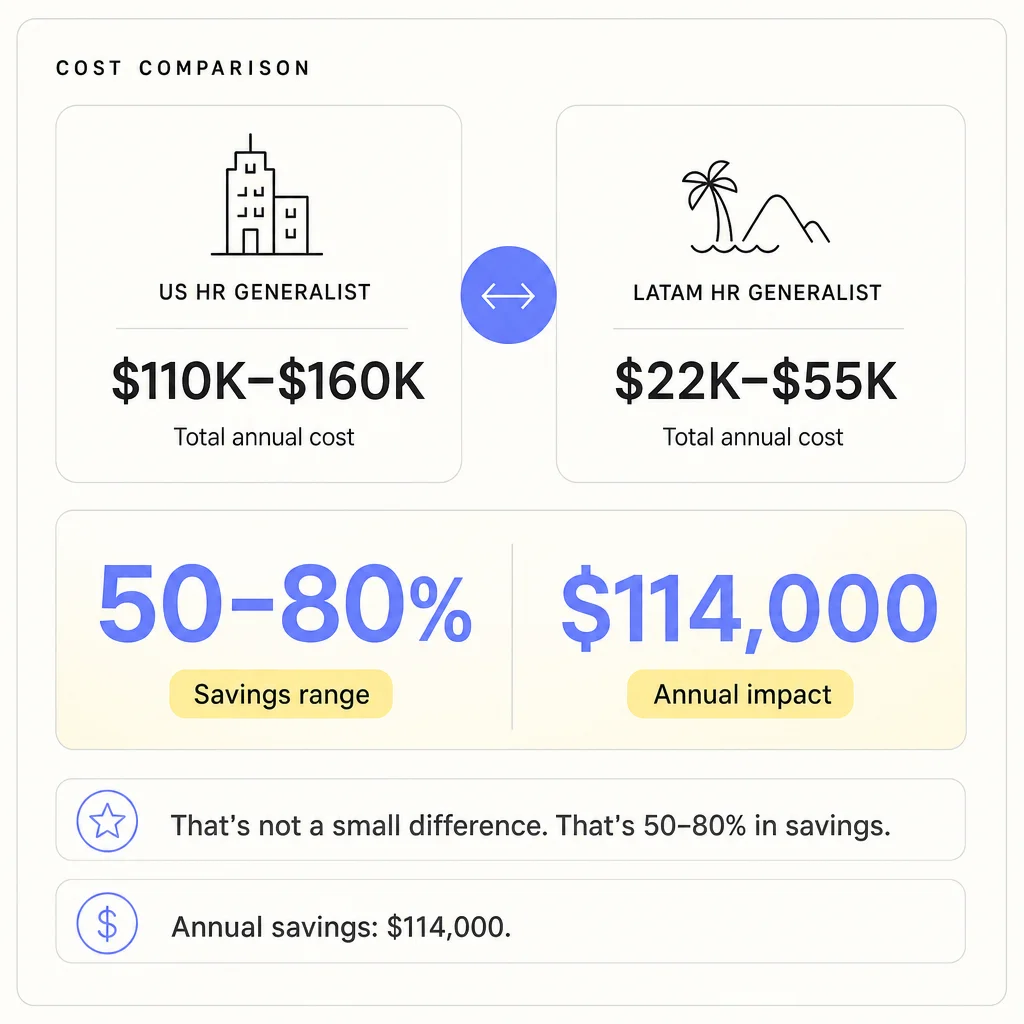
Here’s what most companies pay for an HR Generalist:
United States: $8,000 to $15,000 per month Australia: $9,000 to $16,000 per month
United Kingdom: $7,000 to $12,000 per month
Latin America: $1,500 to $4,000 per month
Same work. Same quality. Same full-time commitment.
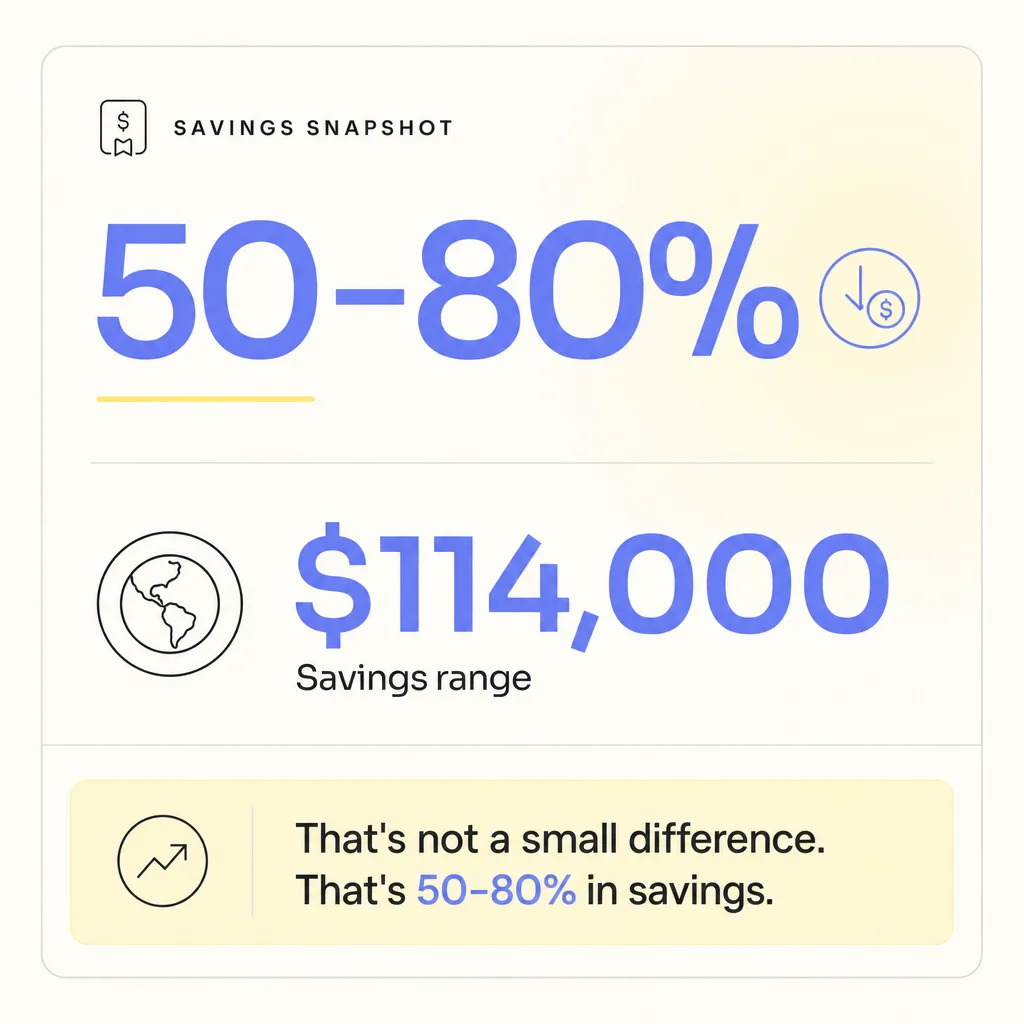
That’s not a small difference. That’s 50–80% in savings.
But here’s what nobody talks about: the salary is just the beginning.
The Hidden Costs That Disappear
When you hire someone in the US, UK, or Australia as an employee, you’re not just paying their salary.
You’re paying:
Health insurance ($5,000–$10,000 yearly)
Payroll taxes (7.65% in the US, more elsewhere)
Equipment and office stipends
Paid time off that you’re still covering
Unemployment insurance
Workers’ compensation
With a remote worker from Latin America working as a contractor?
None of that.
They handle their own taxes. Their own benefits. Their own equipment.
You pay for the work. That’s it.
I’ve seen companies save an additional $60,000 per year just on these hidden costs alone.
But Can They Actually Do the Job?
Fair question.
You’re wondering if someone in Bogotá or Buenos Aires can handle US labor law, manage your onboarding process, or understand the nuances of your company culture.
Short answer: Yes.
Long answer: The HR professionals coming out of Latin America right now are incredibly well-trained. Many have SHRM certifications.
Many have worked with US companies for years. English proficiency is high, especially in countries like Argentina and Colombia.
And here’s something most people miss, the time zones actually work.
Colombia is on EST. Mexico City is on CST. Most of Latin America sits within 2–5 hours of US time zones.
That means real-time collaboration. Morning meetings that actually happen in the morning. Slack messages that get answered during your workday.
What an HR Generalist from Latin America Actually Does
Let’s get specific.
These aren’t just people answering emails about PTO policies.
A solid remote HR Generalist handles:
Recruitment and onboarding – Job postings, screening candidates, running interviews, getting new hires set up
Compliance and documentation – Keeping your employee handbook updated, managing I-9s or equivalent paperwork, staying on top of labor law changes
Payroll coordination – Working with your payroll provider, tracking hours, managing contractor payments
Employee relations – Handling questions, mediating conflicts, managing performance review cycles
Benefits administration – Coordinating with insurance providers, managing enrollment periods
HR systems management – Keeping your HRIS updated, running reports, maintaining employee records
This is full-scope HR work. Not administrative support. Not a virtual assistant.
A professional who can run your entire HR function.
The Smart Way to Hire (Without Getting Burned)
Here’s how companies actually do this successfully.
Start with a trial task.
Don’t just hire someone and hope it works out. Bring them on for a short paid project — audit your current HR policies, rebuild your onboarding checklist, something concrete. You’ll know within days if they’re the real deal.
Platforms like HireTalent.LAT have a built-in trial task system for exactly this. You assign the task, review the submission, and make a call before you commit to anything long-term.
Test English ability upfront.
Ask for a Duolingo English Test score (110+ is solid) or just have a real conversation over Zoom. If communication feels clunky in the interview, it’ll be clunky every day.
Look for specific experience.
“I’ve done HR” isn’t enough. You want someone who’s worked with US companies before, understands 1099 vs W-2 classification, and knows what EEOC compliance means. Check their portfolio. Ask for examples. Get references.
Get payments sorted from day one.
Don’t try to figure out international wire transfers yourself.
Use a platform that handles contractor payments with automatic currency conversion and invoice management built in.
It saves you hours every month and keeps things clean on both sides.
What This Actually Looks Like in Practice
A startup in Austin was paying $12,000/month for a full-time HR manager.
Good person. Did solid work.
But they were burning cash and needed to extend their runway.
They hired an HR Generalist from Colombia at $2,500/month.
Same responsibilities. Same quality of work. Better time zone overlap than their previous person who worked remotely from Seattle.
Annual savings: $114,000.
That’s not a small line item. That’s another engineer. That’s six more months of runway. That’s the difference between making it and not making it.
The Part Nobody Mentions: AI is Making This Even Better
Here’s what’s happening right now in 2025.
AI tools are handling the repetitive parts of HR: resume screening, interview scheduling, basic policy questions, leave tracking.
Which means your HR Generalist can focus on the actual human parts of human resources:
Strategy
Culture
Conflict resolution
Leadership development
You’re getting more value from the same person because 40% of the busywork just disappeared.
Pair a talented HR professional from Latin America with tools like ChatGPT for drafting policies or Notion AI for documentation, and you’ve got an HR function that punches way above its weight.
The Risks (Because There Are Always Risks)
Let’s be honest about what can go wrong.
Not everyone is good at their job.
Just like hiring locally, you’ll meet people who talk a good game but can’t deliver.
That’s why the paid trial matters. That’s why you check references.
Currency fluctuations exist.
If you’re paying in USD (which you should be), you’re mostly protected. But economic instability in some Latin American countries is real.
Lock in 6-month contracts. Build relationships. Treat people well so they don’t jump ship.
Communication can still be tricky.
Even with good English, cultural differences exist. Directness levels vary. Communication styles differ.
Over-communicate early. Set clear expectations. Use video calls, not just Slack.
What You’re Really Paying For
Here’s what I want you to understand.
When you hire an HR Generalist from Latin America, you’re not buying cheap labor.
You’re accessing a global talent pool that wasn’t available to most companies ten years ago.
You’re working with professionals who are every bit as skilled as someone in New York or London, but who can live well on a salary that reflects their local economy.
You’re building a remote-first operation that’s more resilient, more flexible, and more cost-effective than the old way of doing things.
The companies that figure this out now—in 2025—are going to have a massive advantage over the ones still hiring the old way.
The Bottom Line
If you’re paying $10,000/month for HR support, you could be paying $2,500.
If you’re paying $120,000/year, you could be paying $30,000.
That’s $90,000 in savings. Every year.
Same work. Same quality. Better flexibility.
The question isn’t whether you can afford to hire remotely from Latin America.
The question is whether you can afford not to.
Author

Ready to Find Your Next Great Hire?
Join our growing community of employers and start connecting with skilled candidates in Latin America.