
Most marketing teams don’t realize they have a hiring problem until it starts showing up in their results.
Missed deadlines. Campaigns that feel off. A content calendar that’s three weeks behind. A team that’s exhausted and still somehow underwater.
The fix isn’t always more budget or more hours. Sometimes it’s where you’re hiring from.
Here are five signs your digital marketing team should be looking at Latin America right now.
1. Your Team Is Running on a Different Clock Than Your Clients
You’ve tried hiring from Asia. The talent is real. But so is the 12-hour gap.
That campaign that needed to launch yesterday sat overnight because your designer was asleep. The client revision that should have taken two hours turned into a two-day chain of missed messages.
Time zone misalignment doesn’t just slow things down. It compounds. Every async delay pushes deadlines, frustrates clients, and burns out whoever is stuck bridging the gap on your side.
A marketing manager in Bogotá is one hour behind New York. Mexico City runs on Central Time. Buenos Aires is two hours ahead of EST with full workday overlap.
Latin American remote workers are at their desks when your clients are sending emails, when your campaigns are going live, and when something breaks and needs to be fixed immediately.
2. You’re Paying San Francisco Rates for Work That Doesn’t Need to Cost That Much
A senior digital marketing project manager in the US runs around $110,000 a year. In New York or LA, probably more.
That same level of experience in Colombia sits around $45,000.
This isn’t about cutting corners or hiring someone fresh out of school.
Latin American marketing professionals with eight or more years of agency experience have managed international client accounts, built full-funnel campaigns, and worked across the same tools your team uses every day.
Brazilian freelancers are running Meta ad accounts at half the US rate with comparable returns.
Argentine SEO specialists understand technical optimization at a level that competes with anyone.
Mexican content creators have worked with global brands across English and Spanish markets.
The budget difference doesn’t mean a quality difference. It means your dollar goes further and your team can scale without blowing your headcount budget.
3. Your Hispanic Market Campaigns Feel Like Translations, Not Content
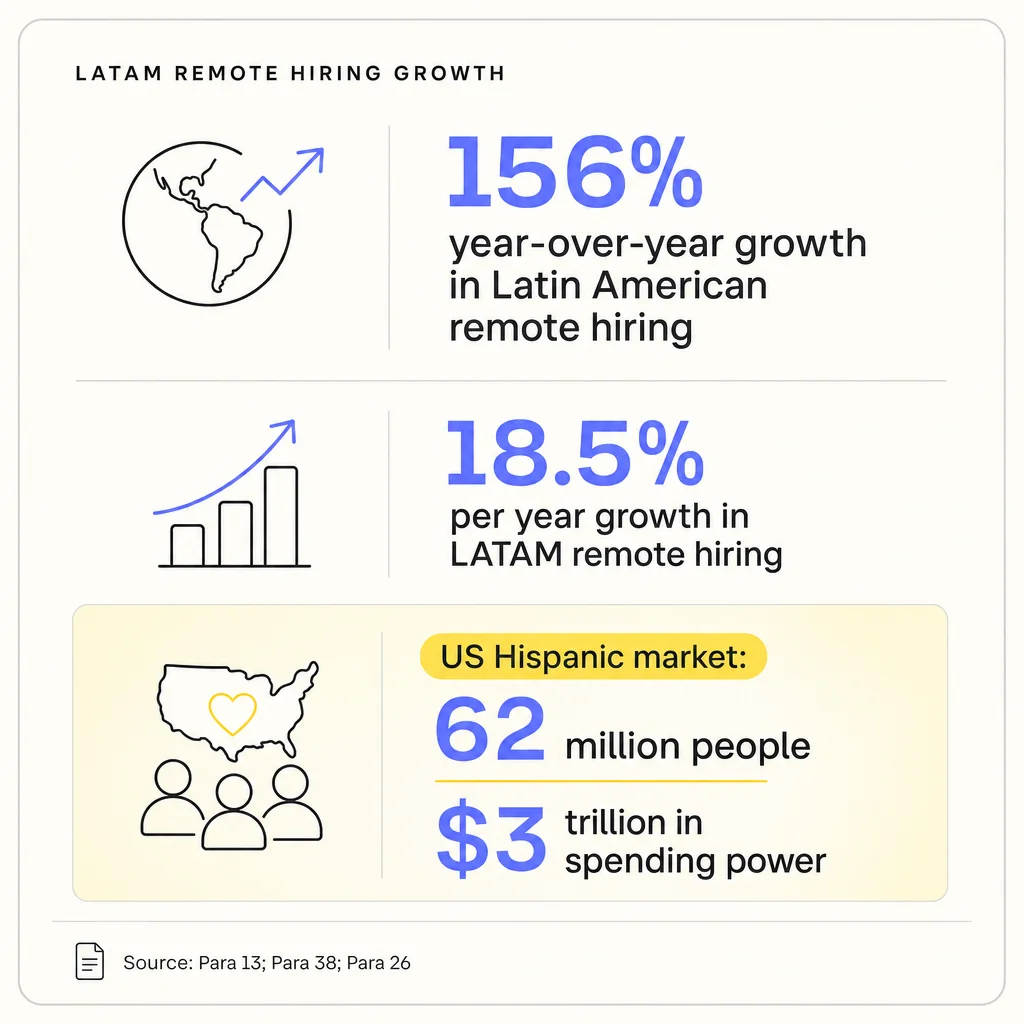
The US Hispanic market is 62 million people with roughly $3 trillion in spending power. Latin American e-commerce grew 25% last year.
If you’re targeting these audiences by taking English content and running it through a translator, or handing it to someone on your team who “speaks some Spanish,” you already know the results feel flat.
There is a real difference between speaking Spanish and understanding how people in Mexico City actually talk versus Buenos Aires versus Miami.
The cultural references, the humor, the way things land on social media. These are not things you can translate your way into.
Hiring marketers who grew up in these cultures is not a diversity initiative. It is a performance decision. Authentic content from people who genuinely understand the audience converts better. Full stop.
4. Your Competitors Are Already Doing This and Pulling Ahead
Latin American remote hiring is growing at 18.5% per year, faster than Asia-Pacific.
While you’re still weighing it up, agencies in the UK, Australia, and across the US are quietly building out LATAM teams. Colombian project managers. Peruvian team leads. Brazilian media buyers. Argentine SEO strategists.
They’re not doing it as an experiment. They’re doing it because it’s working.
The time zone alignment means faster turnaround for clients. The cost structure means more capacity for the same budget. The cultural fluency means better performance in markets that English-first teams consistently underserve.
The competitive gap this creates is not dramatic at first. But over 12 to 18 months, the teams that moved earlier will have built systems, refined their hiring, and pulled meaningfully ahead on output and margin.
Waiting to see how it goes is itself a decision. Just not a neutral one.
5. Your Content Output Has Slowed Down
Your current team is good. They’re also full.
The blog posts are going out late. Social content is getting recycled. The video series you planned in Q1 still hasn’t launched.
Adding headcount in your local market is slow and expensive. A junior hire in a major US city costs $55,000 to $70,000 before benefits and takes three to four months to recruit.
By the time they’re ramped up, you’ve already lost the window.
Latin America gives you access to experienced content creators, copywriters, social media managers, and creative strategists who can be onboarded quickly, work in your time zone, and hit the ground running on a budget that doesn’t require board approval.
If your content engine is stalling because there aren’t enough hands, this is the fastest way to fix it without compromising on quality or breaking your budget.
The Practical Part
International hiring sounds complicated. It used to be. It’s not anymore.
Latin American contractors fill out a W-8BEN form and handle their own taxes in their home country. You don’t withhold US taxes.
If you want full compliance with local labor law and benefits, an Employer of Record service like Deel or Rippling handles everything for a flat monthly fee per person.
Payments move in one to two days through platforms like Wise with minimal fees.
The infrastructure exists. The talent is there. The time zone works.
Platforms like HireTalent.LAT connect you with vetted marketing professionals across Latin America who are ready to work within your business hours from day one.
If two or more of these signs sound familiar, you already have your answer.
Author

Ready to Find Your Next Great Hire?
Join our growing community of employers and start connecting with skilled candidates in Latin America.