
You see the job posting.
$25/hour. Remote. Bilingual support agent. Work from anywhere in Costa Rica. Apply now!
Your heart speeds up a little. This could be it.
But something feels off. The email came fast. Too fast. They want to start immediately. They’re asking for information that seems… weird.
Here’s the thing: the bilingual support industry in Costa Rica is massive and legitimate. Companies like Amazon, tech startups, and established BPOs hire hundreds of remote workers every month. But scammers know this too.
They know you’re looking. They know what you want to hear.
And they’re getting better at sounding real.
Why Costa Rica Attracts Both Real Jobs and Scammers
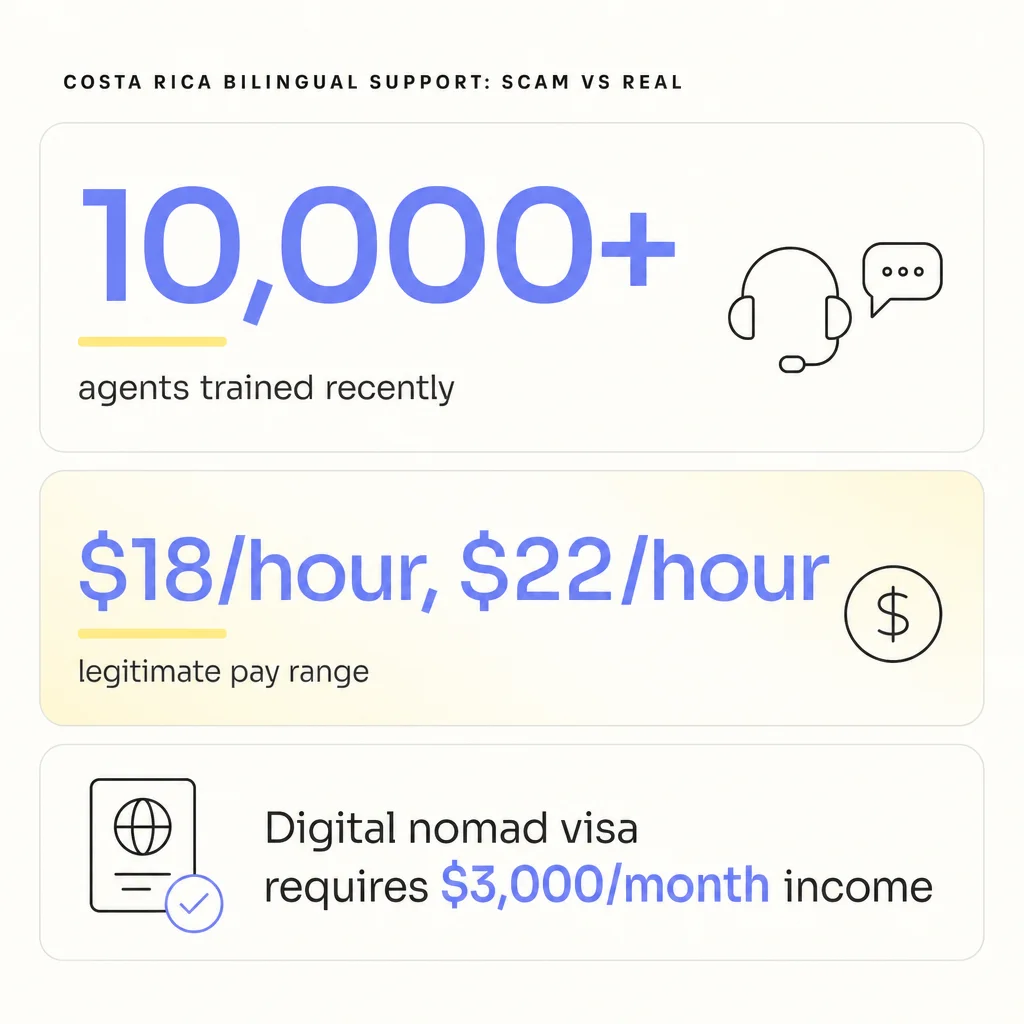
Costa Rica has become a hub for bilingual customer support work. The country has trained over 10,000 agents in recent years, many working remotely for US, UK, and Australian companies.
The demand is real. Your skills are valuable.
But this same demand creates opportunity for scammers. They post fake jobs. They collect your personal information. Sometimes they ask for money upfront for “training” or “equipment.”
The worst part? These scams are designed specifically for Spanish-English speakers in Latin America. They know the market. They know what legitimate offers look like.
So how do you tell the difference?
The Red Flags That Should Make You Stop
Let’s start with what screams “scam” from a mile away.
They ask for money before you start working.
Real companies don’t charge you to work for them. Not for training. Not for equipment. Not for visa processing. Not for background checks.
If someone asks you to pay anything before your first paycheck, walk away.
The pay sounds too good and too vague at the same time.
“Earn $2,000-$5,000 per month!” sounds great. But legitimate jobs tell you the actual rate: $18/hour, $22/hour—specific numbers.
Scammers use ranges because they’re not actually paying anyone.
They want to hire you immediately without a real interview.
A text-only chat isn’t an interview. A scripted phone call with someone reading questions isn’t either.
Real companies want to see you. They want to test your English and Spanish. They want to know if you can actually solve customer problems.
If they’re ready to “hire” you after a 10-minute chat, they’re not hiring you for a real job.
They ask for sensitive information too early.
Your bank account details? Your cédula or passport number? Your mother’s maiden name?
These shouldn’t come up until after you’ve signed a real contract with a real company. Scammers collect this information to steal identities or drain accounts.
What Legitimate Companies Actually Do
Let me tell you what a real hiring process looks like.
First, they have a real website. Not just a Gmail address. Not just a WhatsApp number. An actual company website with an about page, a team, a physical location.
You can find them on LinkedIn. Their employees are on LinkedIn. You can see their history.
Second, they interview you properly. Video calls with real team members. Language assessments. Scenario-based questions about how you’d handle an angry customer or a technical issue.
Companies that actually train agents in empathy and communication want to see these skills before hiring you.
Third, they’re transparent about the work arrangement.
Are you a contractor or employee?
Who pays your taxes?
What platform handles payments?
Is this for a foreign company or a local Costa Rican business?
These questions matter because they affect your legal status and your taxes.
A company like Costa Rica’s Call Center, for example, talks openly about their Fortune 500 clients, their training programs, their office setup. They’re not hiding anything.
Scammers hide everything.
Do Your Homework Before You Apply
Here’s your action plan. Follow these steps for every single job you consider.
Search the company name plus “scam” or “review.”
Check Reddit. Check Glassdoor. Check ScamAdviser. See what people are saying.
If you can’t find anything about the company at all, that’s also a red flag. Legitimate BPOs and remote companies have a digital footprint.
Verify their payment method.
Real companies use established platforms: Deel, Wise, Payoneer, or direct bank transfers with proper contracts.
They don’t use Western Union. They don’t use cryptocurrency. They don’t ask you to cash checks and send money back.
Understand the visa and tax situation.
If you’re working remotely for a foreign company while living in Costa Rica, you need to meet certain requirements. The digital nomad visa requires proof of $3,000/month minimum income and health insurance.
Legitimate employers know this. They’ll provide documentation proving you work for a foreign company with no local clients.
Scammers don’t care about your legal status. They’re not thinking about your taxes or visa compliance because they’re not actually employing you.
Ask for references.
Can you speak to someone who currently works there? Can you see examples of the training materials or scripts you’d use?
Real companies will connect you with team members. They’re proud of their work culture.
Scammers will make excuses.
Test Them Before You Commit
Here’s something most people don’t think to do: test the company before going all in.
Ask detailed questions about the role. What’s a typical day like? What metrics are you measured on? What’s the escalation process for difficult calls?
Companies that actually run call centers can answer these questions immediately and specifically.
Scammers will give vague answers or get defensive.
Request a paid trial or test project through a protected platform like Upwork first. If they’re legitimate, they might agree. If they’re a scam, they’ll push you to start “officially” right away.
Check if they have a real office or operations center. Some companies will do virtual tours. Others will show you their setup during interviews.
One legitimate call center in Costa Rica has pinball machines and gamified workspaces to keep morale up. They talk about this openly. They show it.
What does your potential employer show you?
The Specific Costa Rica Angle
Costa Rica has specific rules about remote work that scammers ignore and legitimate companies follow.
You cannot work for local Costa Rican clients on a digital nomad visa. The work must be for foreign companies only.
Your employer should provide a letter confirming this. They should be clear that you’re working remotely for their US, UK, or Australian operations.
You’ll need to prove your income meets the $3,000/month threshold. Real employers provide contracts and payment documentation that help with this.
Scammers won’t mention any of this because they don’t care if you’re legally compliant.
What to Do If You’re Not Sure
Sometimes a job isn’t an obvious scam, but something still feels off.
Trust that feeling.
Ask more questions. Take your time. A legitimate employer won’t pressure you to decide immediately.
Post in communities like r/digitalnomad or r/cscareerquestionsLATAM. Describe the offer without naming names. People who’ve been through this will spot red flags you might miss.
Look for the company on platforms like hiretalent.lat where employers are vetted and remote work arrangements are structured properly.
The right job will still be there tomorrow. The right company will respect your need to verify them.
Scammers create urgency because they know time works against them.
The Bottom Line
Your bilingual skills are valuable. Companies really do want to hire you for legitimate remote support work.
But you need to protect yourself.
No upfront fees. Ever.
Real interviews with real people. Always.
Verified companies with digital footprints and transparent processes. Non-negotiable.
The job market for bilingual support agents in Costa Rica and across Latin America is strong. You don’t need to jump at the first offer that comes your way.
Do your homework. Ask questions. Verify everything.
The real opportunities are out there. You just need to separate them from the noise.
And when you find the right one? You’ll know because everything will check out. The company will be transparent. The process will be professional. The offer will be specific and clear.
That’s what you’re looking for.
That’s what you deserve.
Author

Ready to Find Your Next Great Hire?
Join our growing community of employers and start connecting with skilled candidates in Latin America.